


Classic Car Storage: A Collector's Guide
Updated: 3 days ago
A roof over a classic car is not, by itself, proof that it’s protected. When considering what to look for in a classic car storage facility, assess the environment, security, care procedures, and access arrangements against the car’s needs and your ownership routine.
Indoor storage can reduce exposure to the elements, but it doesn’t automatically answer questions about moisture, vehicle monitoring, maintenance, or who can access the car. Those concerns matter when a valued vehicle will be away from home for weeks or months. A specialist facility, self-storage unit, or private garage may suit different priorities.
This guide offers a practical framework for comparing storage options, evaluating environmental conditions and accountability, and planning for storage in Long Island. Grand Prix Cafe provides year-round indoor car storage, with GPC Home Service for seasonal or year-round servicing at your property. The GPC Service Department also offers collection and delivery and a 100-point Inspection Service, supporting a broader approach to vehicle care.
What to Look for in a Classic Car Storage Facility
Start with the car’s condition, how long it will be stored, and how often you expect to use it. Then compare the facility’s environment, security procedures, care arrangements, access terms, and written responsibilities. This gives you a consistent way to assess storage options in Southampton, Westhampton, East Hampton, Sag Harbor, and across Long Island and Manhattan.
Table of Contents
What a Classic Car Storage Facility Should Protect
A specialist classic car storage facility does more than provide a roof. It combines an environment suited to the vehicle, defined procedures for handling and access, and care that reflects the car’s condition and intended use. Indoor storage can reduce exposure to weather, but the label alone says nothing about how the space is maintained, who can enter, or what happens while the car is stored.
Vehicle storage provides a place to park. A documented preservation service pairs suitable storage with clear procedures, recorded care, and communication about the vehicle. Premier facilities such as ESP | Exclusive Storage Program exemplify how dedicated automotive care and active preservation protocols differ from standard parking spaces. That distinction helps collectors assess the service, not just the building.
Why classic cars need more than a parking space
Dust can settle on finishes and enter parts of the cabin. Moisture and changing conditions may contribute to corrosion or affect leather, rubber, plastics, and other materials over time. These are potential risks, not guaranteed outcomes. Their likelihood and impact depend on the car’s condition, the storage environment, and how it is prepared and cared for.
Low-use vehicles still need a considered setting. A car parked for long periods may receive less routine attention than one driven regularly, so small changes can go unnoticed. Preservation also involves decisions beyond parking, as reflected in the broader field of Conservation and restoration of road vehicles. Storage should support the owner’s care plan, not replace it.
Which facility qualities matter most to collectors?
Assess five connected areas: environment, security, documented care, access, and communication. No single feature guarantees preservation. Weigh each against the vehicle’s condition and rarity, how often you plan to drive it, and how much oversight you want while it is away.
Environment: Look beyond the word “indoor.” Consider whether the actual space appears clean, dry, and orderly, and whether its conditions suit your car.
Security: Review how entry is controlled and how responsibility for the vehicle is handled. A reassuring building appearance is not a substitute for clear procedures.
Documented care: Identify what care is included, what is recorded, and how additional servicing is arranged. Clear records help establish what has been done during storage.
Access: Match the access arrangements to your plans. A car intended for occasional outings may need different access than one kept off the road for an extended period.
Communication: Establish how updates, observations, and decisions are conveyed. Consistent communication helps owners stay informed without assuming storage includes ongoing maintenance.
A rare, original car may call for closer attention to handling and condition records than a regularly driven vehicle. An owner who values frequent use may prioritize convenient access and servicing arrangements. The right choice is the one whose environment and procedures align with the specific car and the owner’s expectations. These categories provide a practical foundation for comparing storage options.
Assess Environmental Conditions for Long Island and Hamptons Storage
For Long Island and Hamptons owners, assessing a storage environment means looking beyond whether a car is under a roof. Seasonal weather, the vehicle’s previous exposure, and conditions at a particular property all matter. Coastal air can be a consideration near the water, but it shouldn’t be treated as the same risk at every address. Inspect the actual space and its upkeep before deciding whether it suits your car. A practical answer to what to look for in a classic car storage facility begins with the conditions where the vehicle will be kept.
Indoor storage does not automatically mean climate-controlled storage. The term “indoor” describes where a vehicle is kept, not how temperature, moisture, or airflow are managed. A building may offer shelter without maintaining stable conditions, so assess the space itself rather than relying on a broad label. Distinguish between features described in writing and conditions you can observe during a visit.
How to assess ventilation, moisture, and temperature stability
During a visit, look for visible condensation, water staining, damp patches, musty odours, and dust accumulation. Check corners and areas near doors, windows, and drains for signs of water intrusion. Notice whether the space feels stagnant or has a persistent damp atmosphere. These observations don’t establish a building’s full history, but they can identify conditions that need closer consideration.
Ventilation, cleanliness, moisture management, and temperature stability are separate considerations. Review the facility’s written information about how it monitors or manages each, and what procedures apply when conditions change. Don’t assume that heating alone means the environment is stable. Persistent dampness or abrupt temperature changes warrant careful consideration, particularly if the car has vulnerable interior materials or a history of corrosion.
Ventilation: Look for signs that air can circulate rather than remain stagnant.
Moisture: Note condensation, damp surfaces, water marks, or musty odours.
Cleanliness: Check for accumulated dust, debris, and evidence of routine upkeep.
Stability: Review how changes in temperature and humidity are managed, without assuming a particular system is present.
What Long Island owners should consider locally
Storage needs can change with seasonal use. A car driven mainly in warmer months may spend an extended period off the road, while a vehicle used throughout the year may return to storage between outings. Consider how often the car has been exposed to coastal air, wet roads, or changing outdoor conditions, then compare that history with the facility’s environment. These are factors to assess, not predictions of damage. They also help focus your observations during a site visit.
For owners deciding what to look for in a classic car storage facility, the vehicle’s exposure history and planned use can help focus the comparison. An indoor car storage guide can help frame the role of shelter in a preservation plan, but each storage space still needs to be assessed on its own merits. Grand Prix Cafe provides year-round indoor car storage in Southampton, serving collectors across Long Island and the Hamptons. Explore Grand Prix Cafe’s car storage services as part of your vehicle-care planning.
Compare Classic Car Storage Facilities Across Long Island
Storage options differ in more than location. A nearby garage may offer convenient access, while a professional facility may make vehicle care easier to arrange. Knowing what to look for in a classic car storage facility starts with comparing the actual environment, procedures, access terms, and owner responsibilities, rather than assuming one type of building is always superior. This framework helps Long Island and Hamptons owners balance travel distance with the car’s needs and expected storage period.
Specialist facility or general-purpose self-storage?
A specialist facility is organized around vehicle storage, while a self-storage unit is part of a broader storage arrangement. Neither label establishes whether a particular space or agreement suits a collector car. Review the written terms for vehicle eligibility, access, responsibility for the vehicle, and any applicable coverage. Contract and access concerns raised in collector-storage guidance, including American Collectors’, are useful prompts for comparison, not proof that every facility follows the same practices.
Consider how the car will be used. If it may be driven during storage, access arrangements may carry more weight than they would for a vehicle parked for a defined period. Proximity also matters: a closer facility can make visits simpler, but weigh that convenience against the vehicle’s environment and care needs.
Professional storage or a private garage?
A private garage gives the owner direct control over access and routine observation. That control comes with responsibility for the space, its environment, security, and maintenance arrangements. Professional storage may suit owners who prefer a dedicated vehicle-care relationship, but the actual service and oversight depend on stated procedures and written terms. Compare those responsibilities with the level of involvement you want.
Include maintenance in the comparison, not just parking. Consider how servicing will be coordinated during storage and who will oversee it. A classic car service overview offers related maintenance context. Grand Prix Cafe provides year-round indoor car storage, and year-round indoor storage options can form part of a broader preservation plan.
There is no single answer to what to look for in a classic car storage facility. The right fit depends on the car’s condition and rarity, how often you expect to use it, the storage duration, and how much oversight you want. Use the comparison to identify trade-offs, then review the facility and its terms against those priorities.
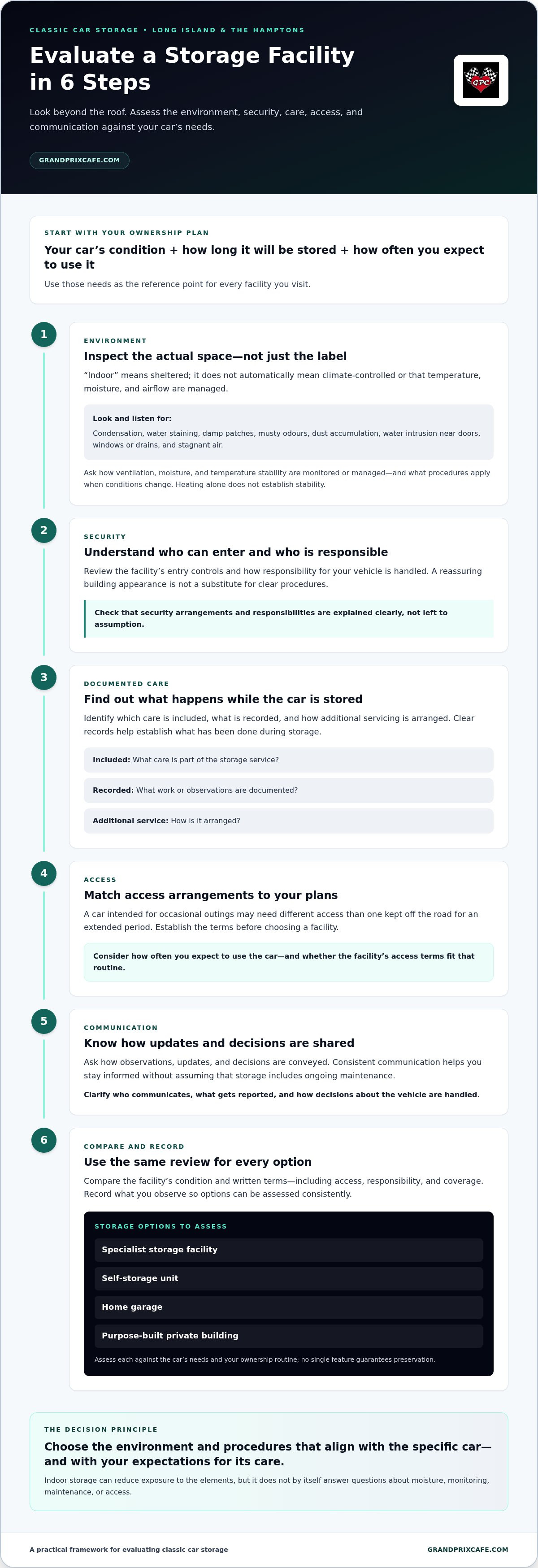
Use This Checklist to Evaluate a Long Island Storage Facility
A consistent review makes it easier to separate a reassuring first impression from clear, useful procedures. Use the same sequence for each option, record what you observe, and compare the information with your car’s condition, intended use, and storage period. This process also helps identify details to resolve in writing before you commit.
Inspect the space. Look at the specific area where the vehicle would be kept. Note cleanliness, signs of moisture or water intrusion, general upkeep, and how vehicles are arranged. Record observations rather than relying on broad descriptions such as “secure” or “indoor.”
Review the procedures. Establish how access is managed, what routine checks are performed, and how concerns or changes are communicated. Identify which vehicle-care services are included and how completed work is documented. Clear, direct information helps you understand day-to-day operations.
Review the written terms. Read the agreement for access rules, vehicle eligibility, responsibilities, and any applicable insurance or coverage provisions. Distinguish what the facility agrees to do from what remains the owner’s responsibility. Don’t treat a verbal explanation as a substitute for written terms.
Document the details. Keep a record of your observations and the procedures described. Note care arrangements and anything that remains unclear. This creates a useful reference when comparing options or reviewing an agreement.
Compare and decide. Assess each option against the same categories: environment, security procedures, communication, access, and care. Match documented services to the car’s condition and expected storage duration. Choose based on the overall fit, not one attractive feature or a polished presentation.
During a visit, pay attention to how staff explain their processes. Can they describe how a concern is reported? Do they distinguish routine storage from additional servicing? Are responsibilities consistent with the written agreement? These are practical indicators of communication and process, not guarantees about a vehicle’s outcome.
For an even comparison, use one set of notes for every option. Include the date of your visit, observations about the space, access and care procedures, and relevant agreement terms. If applicable coverage is addressed in separate documents, record what those documents say without assuming that storage automatically includes protection under a particular policy.
A useful storage checklist records what you see, what the facility does, what the agreement states, and how each point fits the car’s needs. That standard keeps the decision grounded in evidence and makes it easier to identify unanswered questions before choosing.
Grand Prix Cafe provides year-round indoor car storage as part of a broader approach to vehicle care. Explore Grand Prix Cafe’s car storage services as you plan storage for your vehicle.
Grand Prix Cafe Storage and Vehicle Care for Collectors
Once you’ve compared facility conditions, procedures, and written terms, consider how storage fits with the car’s wider care plan. Grand Prix Cafe provides year-round indoor car storage in Southampton for collectors across Long Island and the Hamptons. The value of a storage arrangement also depends on how servicing, inspections, and vehicle logistics fit around the time the car is away. Assess these services against the vehicle’s condition, intended use, and expected storage period.
Storage supported by vehicle servicing
The GPC Service Department offers vehicle collection and delivery, original-part restoration, and a 100-point Inspection Service. The inspection covers mechanical, exterior, interior, safety, and security checks. These areas help owners consider the car’s condition beyond its storage location. Storage and scheduled maintenance can form parts of one ownership plan, with work selected to suit the vehicle rather than assumed to be included automatically.
For owners who prefer care at home, GPC Home Service provides year-round and seasonal servicing, detailing, maintenance, and customized property-management solutions at the customer’s property. This can help coordinate vehicle care around a seasonal routine, whether a car is being prepared for a period of use or attended to while stored at home. The appropriate plan depends on the car and the owner’s priorities.
Grand Prix Cafe’s indoor storage service details provide additional context for owners considering year-round indoor storage. Storage, inspection, and servicing are distinct considerations, so review each in relation to your vehicle’s needs. Knowing what to look for in a classic car storage facility can help you decide which parts of care you want coordinated and which you will manage separately.
Plan the next step around your vehicle
Before arranging storage, note the car’s current condition, how long it is expected to remain stored, and how often you may want access. A vehicle that will be driven seasonally may call for a different schedule of servicing and logistics than one kept off the road for a longer period. A concise plan also makes it easier to decide which combination of storage and care suits your needs.
Condition: Record known maintenance needs and areas that may warrant inspection.
Storage period: Identify whether your plan is seasonal or year-round.
Access and logistics: Consider how the car will reach storage and return to use.
Care preferences: Decide whether servicing, detailing, or maintenance at home fits your routine.
The GPC Service Department’s collection and delivery service offers a practical option for vehicle logistics. Grand Prix Cafe’s Full Diagnostic Service Center is also available for vehicle diagnostic needs, including specialized diagnostics for Ferrari, Lamborghini, and Maserati. For Long Island-area collectors considering storage alongside vehicle care, explore classic car storage with Grand Prix Cafe.
Make Your Storage Decision With a Clear Plan
Before settling on a facility, turn your priorities into a brief written plan. Note the car’s present condition, how long you expect it to be stored, when you may want to use it, and what level of oversight suits you. This gives you a practical reference for the agreement and keeps the decision tied to the vehicle rather than convenience alone.
The question of what to look for in a classic car storage facility has no single answer for every collector. A car driven seasonally, a long-term project, and a rarely used original vehicle can call for different arrangements. Your decision should reflect those distinctions and the care you intend to continue while the car is away.
Grand Prix Cafe offers year-round indoor storage and vehicle-care options for collectors in Southampton, the Hamptons, and Long Island. Bring your priorities into the planning process, then choose the arrangement that best suits your ownership routine. Contact Grand Prix Cafe to plan storage and care for your classic car.
Frequently Asked Questions
Is my classic car automatically insured while it is in storage?
No. Don’t assume a storage fee includes insurance or that your current policy covers every storage arrangement. Review your policy and the facility agreement together, noting the vehicle’s stated value, storage location, permitted access, and who is responsible for damage. If the car’s use or location changes, the policy terms may matter. Confirm coverage with your insurer and keep written records of the arrangements.
Can I store a classic car that is not currently roadworthy?
Possibly, but the car’s condition affects how it can be moved and positioned. Before arranging storage, record whether it starts, rolls, steers, or has known mechanical issues. Share those details in writing and understand the receiving and moving process before transport. If the car can’t be driven, collection and delivery can help with logistics. Grand Prix Cafe offers vehicle collection and delivery, and the vehicle’s condition is an important part of planning.
How often should I visit a classic car in storage?
There’s no single visit schedule that suits every vehicle. Consider the car’s condition, the length of storage, the facility’s procedures, and the access terms in your agreement. For example, an owner storing a car through the off-season may arrange updates and visits differently from someone who expects to drive it intermittently. Establish how concerns will be communicated, and keep dated notes of your own observations.
What should a classic car storage agreement include?
A storage agreement should clearly state the storage period, access arrangements, owner and facility responsibilities, and any vehicle-care terms. Review how it addresses damage, insurance, and permitted use of the vehicle. Keep a copy with your service records and other vehicle documents. If the agreement refers to separate coverage documents or procedures, retain those as well. Resolve unclear wording before leaving the car so expectations are documented.
Does indoor storage always mean a classic car is climate-controlled?
No. “Indoor” indicates that a car is kept inside, but it doesn’t describe how temperature or humidity are managed. Review the stated environmental conditions and how ventilation, moisture, and water intrusion are handled. Then consider whether those conditions suit the car’s materials and the planned storage period. For instance, a vehicle with original leather or aging rubber components may warrant a closer look at the environment than the label alone provides.
Can a storage facility arrange collection and delivery for a classic car?
Some vehicle-service businesses provide collection and delivery, which can help when a classic car shouldn’t be driven or isn’t roadworthy. Clarify the transport route, timing, handover process, and responsibilities before the vehicle moves; professional vehicle transport providers like donewrighttowing.com.au exemplify the dedicated equipment and care needed to relocate non-running or delicate vehicles safely. Photograph its condition and note any keys, documents, or other items transferred with it. Grand Prix Cafe offers vehicle collection and delivery, giving owners a way to plan storage or servicing without driving the car themselves.
Should I choose a storage facility close to home or one with more services?
Choose by weighing the car’s protection needs against location, access, communication, and care arrangements. A nearby facility can make visits easier for an owner travelling from Manhattan to a car in Southampton or East Hampton. A broader service offering may reduce the need to coordinate maintenance separately. There’s no universal best choice. Compare options against the same criteria, then select the arrangement that fits the vehicle and your ownership routine.
Comments